
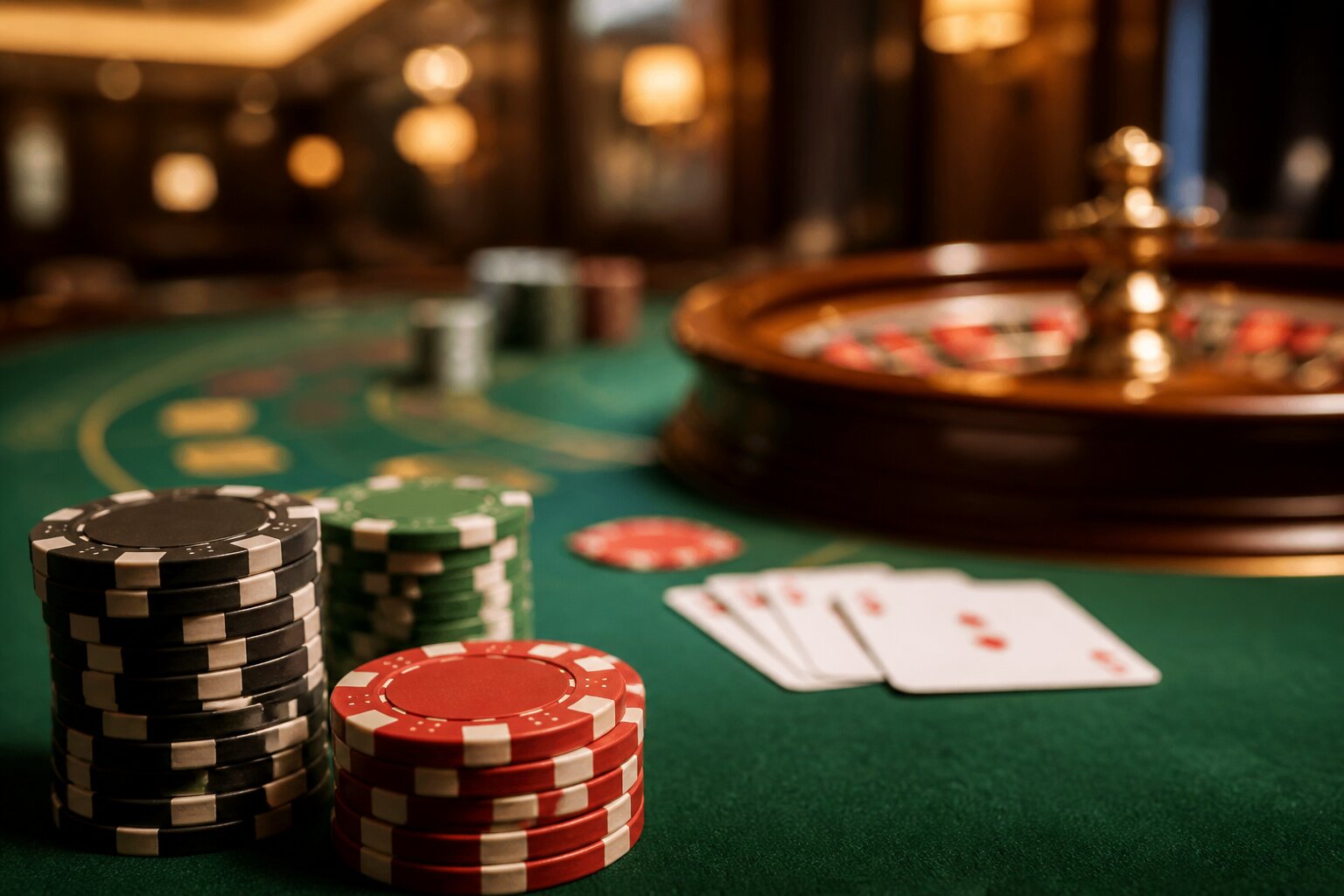
Trying to decide whether to play blackjack or roulette? You’re not alone. Both are classic casino games with long histories, but they offer very different experiences in terms of decision-making, bet types and mathematical odds.
Maybe you enjoy the tactical choices in blackjack, or perhaps you prefer the straightforward bets and spectacle of roulette. Knowing how each game works — and how the numbers behind them stack up — helps you choose the one that fits your playstyle and budget.
Below we compare rules, odds, payouts and the house advantage so you can make an informed choice about which game to try.
Understanding the Rules: Blackjack and Roulette Explained
Blackjack is a card game played against the dealer with a clear objective: get a hand value as close to 21 as possible without exceeding it. Each player and the dealer receive two cards to start. Numbered cards carry their face value, face cards count as 10, and aces can be 1 or 11 depending on what best suits the hand. Players decide whether to take more cards (“hit”) or stop (“stand”), and there are options like splitting pairs or doubling a bet in certain situations. After players finish, the dealer plays by fixed rules and whoever is closer to 21 without exceeding it wins.
Roulette is centred on a spinning wheel and a betting layout. The wheel has numbered pockets in red and black plus at least one green zero. Players place chips on numbers, groups of numbers, colours or odd/even outcomes. Once the wheel is spun, the ball lands in a pocket and bets are settled according to the type of bet placed. Some bets cover a wide range of numbers and pay small multiples, while straight-up single-number bets offer the highest payout when successful.
Next, we’ll see how these structural differences translate into actual chances of winning.
Which Game Offers Better Odds?
Blackjack’s odds depend on player decisions and table rules. With sound strategy, the player’s chance of winning a single hand typically sits just under 50%. Choices such as hitting, standing, splitting and doubling down change the probability of particular outcomes, and optional side bets usually carry a much higher house advantage.
Roulette’s odds vary by bet type and wheel variant. In European roulette with a single zero, a straight-up bet on a single number has a 1 in 37 chance of success; even-money bets such as red/black or odd/even are close to 50% but slightly lower when the zero is factored in. American roulette, with an extra double zero, reduces win probabilities further across all bets because the wheel has more losing pockets. Each spin is an independent random event, so the probability for a particular outcome does not change based on previous spins.
Understanding how odds behave in each game sets the scene for comparing payouts, which we cover next.
Payouts Compared: How Much Can You Win?
Blackjack typically pays even money for a standard win: a £10 stake returns £10 in winnings plus the original £10. A natural blackjack — an ace with a ten-value card — is commonly paid at 3 to 2, so a £10 stake returns £15 in winnings plus the original stake. Ties, or pushes, leave the player’s stake unchanged. Side bets and different rule sets can produce varied payout structures and generally raise the house advantage.
Roulette payouts scale with the risk of the bet. A single-number (straight-up) win usually pays 35 to 1, so a £1 stake becomes £36 in total. Even-money bets like red/black or odd/even return 1 to 1. Other bet types such as splits, streets and corners sit between these extremes, offering progressively lower payouts for broader coverage of the wheel. While larger payouts are possible on individual roulette bets, higher returns tend to come with much lower probabilities.
Because payout size and probability move in opposite directions, it helps to view each bet as a balance between risk and potential reward — and next we look at how that balance is reflected in the house edge.
House Edge Breakdown: Blackjack vs Roulette
The house edge is a long-term statistical advantage the casino holds over players; it represents the average percentage of each stake that the house expects to retain over many plays. It does not predict short sessions or single hands, but it is the key figure for comparing games over time.
House Edge in Blackjack
When players follow a solid basic strategy and table rules are favourable, blackjack’s house edge can be around 0.5% or slightly higher. Small changes in rules — number of decks, dealer behaviour on soft 17, payout for blackjack, and restrictions on doubling or splitting — move that figure up or down. Optional wagers such as insurance, side bets or promotions usually come with a much larger house edge, so they have a greater long-term cost.
House Edge in Roulette
Roulette’s house edge is tied to the wheel layout. On a single-zero wheel the house edge is roughly 2.7%; on a double-zero wheel it rises to about 5.26%. Unlike blackjack, the house edge in roulette is the same for virtually all bets on a given wheel, so selecting European or single-zero variants improves the player’s expected return relative to double-zero tables. Special rules like la partage or en prison in some single-zero games can reduce the effective loss on even-money bets, improving the player’s prospects for those specific wagers.
With house edge clear, the next section shows how table variations in each game influence those numbers and what to watch for when choosing where to play.
Table Variations That Affect Odds and Payouts
Small rule changes at a table can have an outsized impact on expected returns in both blackjack and roulette. For roulette, the main differences are the number of zeros and any additional rules that modify outcomes for even-money bets. A single-zero wheel gives better mathematical value than a double-zero wheel, and options that allow partial returns on zero can further soften losses for certain bets.
Blackjack tables vary in the number of decks, whether the dealer hits or stands on a soft 17, blackjack payout ratios, and whether doubling after splitting is allowed. Each rule nudges the house edge one way or another; for example, a 6-to-5 payout for blackjack rather than 3-to-2 raises the house edge noticeably. Players who focus on tables with player-friendly rules will see the best theoretical returns over time.
Knowing which rule changes matter helps when choosing a table, and the next section looks at common misconceptions that can cloud decision-making.
Debunking Common Myths About Blackjack and Roulette
A few persistent myths can mislead players about how outcomes behave and what strategies can achieve. One is the idea that a roulette number or colour is “due” after a long absence; each spin is an independent random event, so past results don’t alter future probabilities. Betting systems that escalate stakes after losses, such as doubling schemes, confront table limits and volatile bankroll swings and do not change the underlying expected return.
In blackjack, perfect strategy reduces the house edge but does not convert the game into a guaranteed winner. Counting cards alters the probability of certain future outcomes in a single-deck or fixed-shoe game, but casinos have countermeasures and it is not feasible in many modern or online formats where shuffling occurs frequently. In all cases, techniques that promise certainty overlook the statistical framework that governs long-term results.
Clearing up these misunderstandings makes it easier to pick a game aligned with goals and temperament, which is what we explore next.
Choosing the Right Game: What Suits Your Playstyle?
Deciding between blackjack and roulette comes down to what you want from the session. Roulette suits players who favour simple, self-contained bets and rapid rounds with clear payoffs. Blackjack appeals to those who enjoy applied decision-making and marginal gains achieved through correct choices during play.
Consider the tempo and level of involvement you prefer: blackjack sessions tend to be steadier with time between decisions, while roulette delivers quick resolution and a changing range of betting options. Bankroll considerations matter too — games with lower house edge and bets that suit your stake size help preserve playtime. Set personal limits, choose tables with favourable rules where possible, and treat play as entertainment rather than a method for income. If ever gambling starts to feel like a problem, support services are available and it is important to seek help.
With those practical points settled, the final section brings everything together.
Conclusion: Which Casino Classic Comes Out on Top?
Blackjack and roulette each offer distinct appeals: blackjack gives strategic depth and a lower theoretical house edge under good rules, while roulette delivers simple betting choices and high single-bet payouts at lower probability. The choice depends on whether you prefer the involvement of decision-making or the straightforward anticipation of a spinning wheel.
Mathematical differences — in odds, payouts and house edge — should guide expectations, but outcomes for any session remain governed by probability and randomness rather than certainty. Pick the game that matches your temperament, stick to limits that suit your finances, and prioritise enjoying the experience. If gambling ever becomes a concern, there are confidential services and advice available to help; seeking support is a sensible step.
**The information provided in this blog is intended for educational purposes and should not be construed as betting advice or a guarantee of success. Always gamble responsibly.