
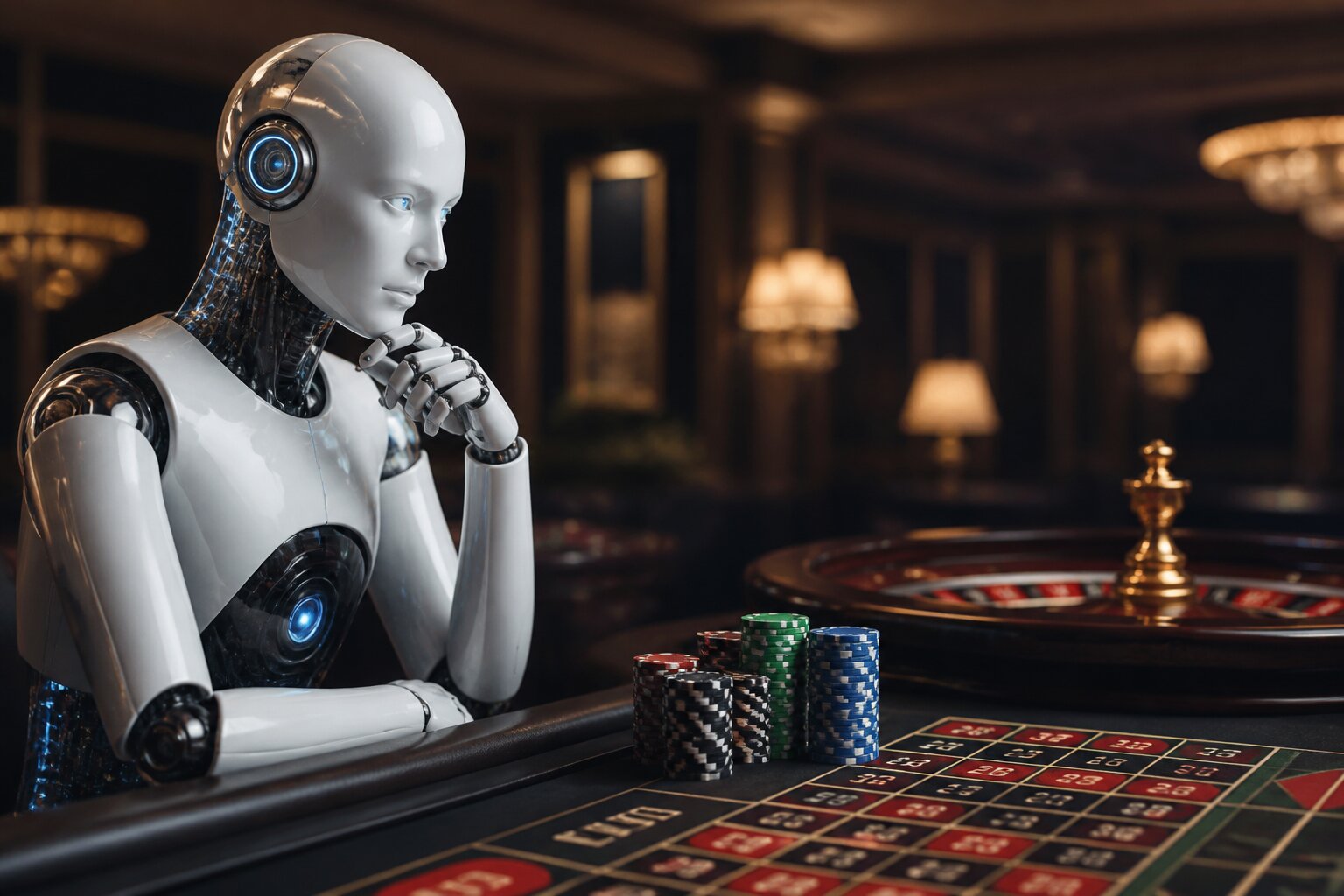
Imagine a clever computer programme that could predict exactly how a casino game will turn out. It sounds like something from science fiction, doesn’t it?
With AI advancing so quickly, it’s natural to wonder whether these systems could give someone an unbeatable edge at the casino. Headlines often make bold claims, but the reality is more measured.
Here we separate fact from fiction so you can understand what AI can and cannot do in gaming.
How Do AI Betting Bots Work?
AI betting bots are programmes designed to help make decisions about placing bets. They rely on algorithms to process large volumes of data—past game outcomes, player behaviour, or betting patterns—and identify statistical relationships that might inform a choice.
These systems can act faster than a person and alter their approach as new information arrives. That can make the betting process more efficient: bots can execute many small decisions without fatigue and maintain a consistent approach to the parameters they are given.
However, casino games include mechanisms intended to keep each outcome independent and fair. Because of that, no matter how advanced the algorithms, a bot cannot guarantee the outcome of any single game. The most realistic role for these programmes is to manage information and execution, not to foresee results with certainty.
Understanding the Technology Behind AI Gambling Bots
Two main techniques underpin most gambling bots: machine learning and data analysis. Machine learning works by having the system learn patterns from historical data and adjust its internal models to improve predictions on similar inputs. Data analysis is the process of preparing and interpreting that information so the model can draw usable conclusions.
For instance, a bot might detect that certain bet sizes correlate with particular short-term outcomes in a dataset, or it might model common player behaviours to estimate likely moves in card games. Those patterns can guide decisions, but they are probabilistic, not deterministic.
It’s also important to note that the quality of any model depends on the data. If the data does not reflect current game conditions or is biased, the model’s outputs will be unreliable. In many casino environments, operators design systems specifically to prevent predictable patterns, which reduces what AI can reliably exploit.
Because of these technical limits, AI can help with analysis and consistency, but it does not overturn game design or regulation that ensures independent outcomes.
Are AI Predictions Accurate in Casino Betting?
AI can be useful for recognising trends in historical data and scoring the relative likelihood of different outcomes, but that is not the same as accurate prediction of a single event. Games such as slots, roulette and blackjack use mechanisms to ensure results are independent and conform to their mathematical rules.
Advanced models sometimes produce probabilities that look convincing in retrospect, yet they still rest on past observations. When a game’s mechanism prevents past outcomes from influencing future ones, predictive accuracy for individual events becomes inherently limited.
So while AI can refine decision-making frameworks and quantify risk, it cannot deliver consistent, guaranteed wins. The realistic benefit lies in better-informed choices and improved operational reliability rather than in changing fundamental game results.
Myths and Misconceptions About AI in Gambling
Many online stories claim AI can crack casino systems or guarantee success. Those claims overlook how games are engineered and regulated to maintain fairness.
A common misconception is that an AI bot automatically produces profits. In practice, any model that seems to outperform for a time can later fail when conditions change or when the dataset used to build it no longer applies. Casinos update systems and procedures precisely to avoid predictable exploits, and regulations require fair play for all customers.
Scepticism is healthy when you encounter grand promises. If a tool suggests it can guarantee winnings, that is a clear red flag. Trustworthy approaches focus on transparency, documented performance under varied conditions, and compliance with the rules that protect players and the integrity of games.
What Are the Legal and Ethical Issues of AI in Gambling?
AI use in gambling raises both regulatory and ethical questions. Many operators do not permit automation that gives an unfair advantage, and using such tools can lead to account suspension or forfeiture of funds. Regulators set standards to protect players and uphold the integrity of games, and operators enforce those standards in their terms and conditions.
Ethically, fairness and player protection are central. Automated tools that attempt to circumvent rules undermine equal treatment and can harm vulnerable customers. The industry and regulators increasingly expect operators to use AI to enhance safety and compliance rather than to facilitate advantage-seeking behaviour.
If you engage with gambling services, doing so within the framework of the rules and being aware of the legal boundaries around automation helps prevent disputes and protects your account standing.
Risks and Limitations of Using AI for Casino Games
There are practical and personal risks to relying on AI bots. Financially, models can underperform and lead to losses, particularly if they are overfitted to historical data or used in environments that change. From an account perspective, using unauthorised automation can result in restrictions or closure and the loss of winnings.
On a personal level, automated systems can shift focus from enjoyment to an unhealthy preoccupation with trying to outsmart the system. That change in behaviour is precisely what regulators and operators monitor, and they provide tools and limits to help players stay within healthy patterns.
If concerns arise about play patterns, operators offer measures such as deposit limits, session reminders and self-exclusion options. Independent organisations also provide guidance and support for anyone who feels they are losing control. These resources are part of a broader framework aimed at player protection.
The Future of AI in Casino Betting
AI is likely to become more prominent in gambling, but the most valuable applications are those that support safety, fairness and security rather than prediction. One key area is player protection, where AI can detect rapid changes in behaviour and trigger interventions that encourage safer play.
Another important role is fraud and abuse detection. AI systems can monitor large-scale activity to identify bots or collusion, helping operators keep the playing field even. These uses strengthen trust in the system without altering the underlying mechanics of games.
As AI tools develop, the emphasis will remain on enhancing safeguards and upholding regulatory standards. That makes them useful allies for operators and players alike, provided they are applied transparently and within the rules.
At the end of the day, AI can improve how casinos operate and how players are protected, but it does not remove the core limits embedded in game design or replace the need to play within the rules.
**The information provided in this blog is intended for educational purposes and should not be construed as betting advice or a guarantee of success. Always gamble responsibly.