
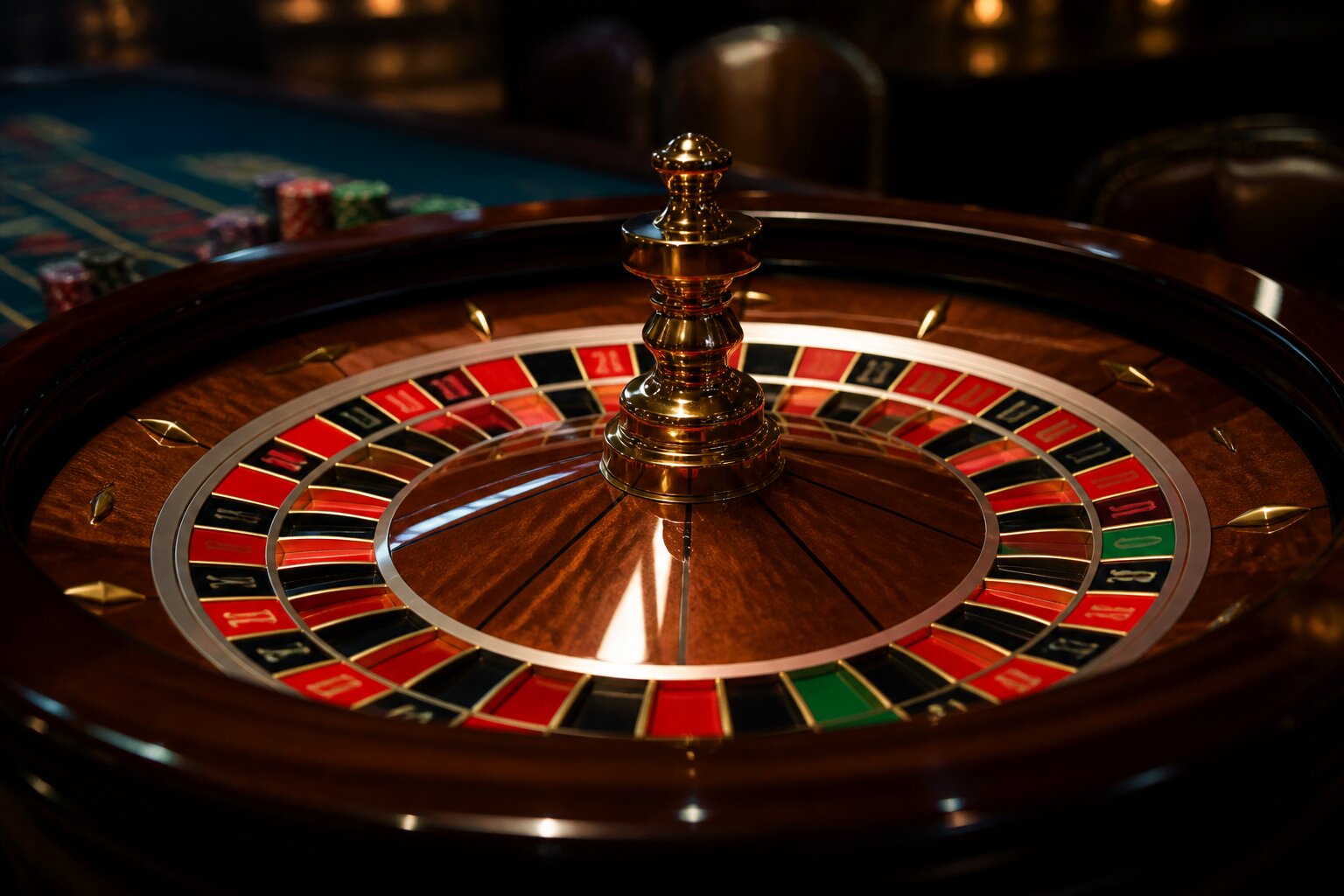
Roulette has fascinated casino players for centuries, combining simple rules with plenty of decision-making at the table. If you’ve ever watched the wheel turn and wondered exactly how many numbers are in play, you’re not alone.
This article breaks down the wheel’s layout, explains the differences between the main versions, and clears up common misunderstandings so you can follow the game with confidence.
Roulette Wheels: What Are They Used For?
The roulette wheel is the central device that determines each round’s outcome. Its spinning motion and numbered pockets create the moment of suspense as the ball settles into a slot.
Beyond the spectacle, the wheel’s design serves practical purposes. The numbered slots and their colours organise the game and support the range of bets players can place. In both physical and digital formats, rules and controls are in place to keep results fair and consistent, so the wheel does its job without outside influence.
Roulette is intended as entertainment, so it helps to set limits and stick to them. With sensible play you can enjoy the game without it taking over your plans.
To move from that big-picture role to the details, let us look at how a wheel is actually laid out.
What Is the Layout of a Roulette Wheel?
A roulette wheel consists of a rotating disc with pockets around its rim, each pocket marked by a number and a colour. The numbers are not arranged in simple numerical order; instead they follow a set sequence chosen to balance high and low numbers and to alternate colours as much as possible.
Most wheels use red and black pockets for numbers 1 to 36, while the zero pockets are green. European and French wheels have a single green zero. American wheels include both a single zero and a double zero. Those green pockets are important because they change the maths behind certain bets.
With the layout in mind, the next section compares the exact number of slots you’ll find on the two main wheel types.
How Many Numbers Are on European vs American Roulette Wheels?
Different versions of roulette use slightly different wheels. The two most common layouts are European and American, and the total number of pockets differs by one.
European Roulette Wheel
A European roulette wheel has 37 pockets. These are:
- the numbers 1 to 36, and
- a single green zero.
The pockets numbered 1 to 36 alternate between red and black, while the zero is green. Because there are 37 possible outcomes, the probability of any single number coming up on a straight bet is 1 in 37.
This layout produces a house edge of about 2.70% on single-number bets when those bets pay 35 to 1. The maths behind that is straightforward: the payout odds remain at 35 to 1 but the true chance is 1 in 37, so the expected return is slightly below the fair 36 to 1.
American Roulette Wheel
An American roulette wheel has 38 pockets. These are:
- the numbers 1 to 36,
- a single green zero, and
- a green double zero.
The extra double zero pocket changes the probabilities. With 38 possible outcomes, the chance of a specific single number on a straight bet is 1 in 38. Because most casinos keep the same 35 to 1 payout for a straight bet, that change in probability increases the house edge.
On an American wheel the typical house edge for single-number bets is about 5.26%. In simple terms, the additional pocket makes the expected return lower for players compared with the European layout.
These differences are relatively small in appearance but matter in mathematical terms. They affect the probability of each outcome and therefore the effective house edge on many common bets.
If you want to compare how this matters in practice, look at both:
- the precise payout ratios, and
- the probability of each outcome on the given wheel.
Now that you know how many pockets are on each wheel, the next question is why those differences exist.
Why Are There Different Numbers of Slots?
The varying number of pockets is mostly a matter of historical development and design choices. The single-zero format originated in France, while the double-zero variant became established in America. The additional zero on the American wheel increases the casino’s edge slightly, which is why the two styles persist as distinct options.
Casinos and game designers kept both formats because players came to expect each region’s version. Today both are widely available, and the choice between them often comes down to player preference and the exact rules of the game being offered.
With that history in mind, it helps to understand what the colours and numbers actually represent.
What Do the Numbers and Colours on Roulette Wheels Mean?
Each numbered pocket has a clear role in the range of bets available. Numbers 1 to 36 are split between red and black, which allows for colour-based betting. Other bets use the numerical value, whether that is odd or even, high or low, or specific groups of numbers.
The green zero pockets are separate because they are not part of those even-money categories. When the ball lands in green, many common bets lose, which is how the house margin is incorporated into play.
These design choices are about game structure rather than predicting outcomes. Knowing what each pocket represents makes it easier to follow the betting options and to understand why different bets carry different payouts.
Next, let’s tackle some of the myths that often surround roulette numbers.
Debunking Common Myths About Roulette Wheel Numbers
Roulette carries its share of myths. One frequent idea is that some numbers tend to appear more often. Statistically, each pocket has the same probability on any given spin, so no number is inherently more likely to turn up over time.
Another misconception is that tracking past results can reveal a pattern to exploit. The wheel’s design and the mathematical structure of the game mean that previous spins do not change the probabilities of future ones. Betting systems that rely on perceived streaks or patterns do not alter the underlying odds.
If you find the subject of probabilities interesting, consider comparing the expected return on different bet types to see how payouts relate to the chance of winning. That comparison is the clearest way to judge which bets suit your approach to the game.
To finish, here is a concise recap that pulls the main points together.
Summary: Understanding All the Numbers on a Roulette Wheel
Knowing the layout and pocket count on roulette wheels clarifies how the game is structured. European wheels have 37 pockets, American wheels have 38, and the green zero pockets create the house edge that distinguishes bet payouts.
The colours and numbers provide a clear framework for the variety of bets players can make, but they do not change the probabilities from one spin to the next. With that understanding, you can follow play confidently and choose bets that fit your preferences.
If you need help managing play, our responsible gambling resources are available to offer advice and tools. Enjoy the game within your own limits, and thanks for reading.
**The information provided in this blog is intended for educational purposes and should not be construed as betting advice or a guarantee of success. Always gamble responsibly.